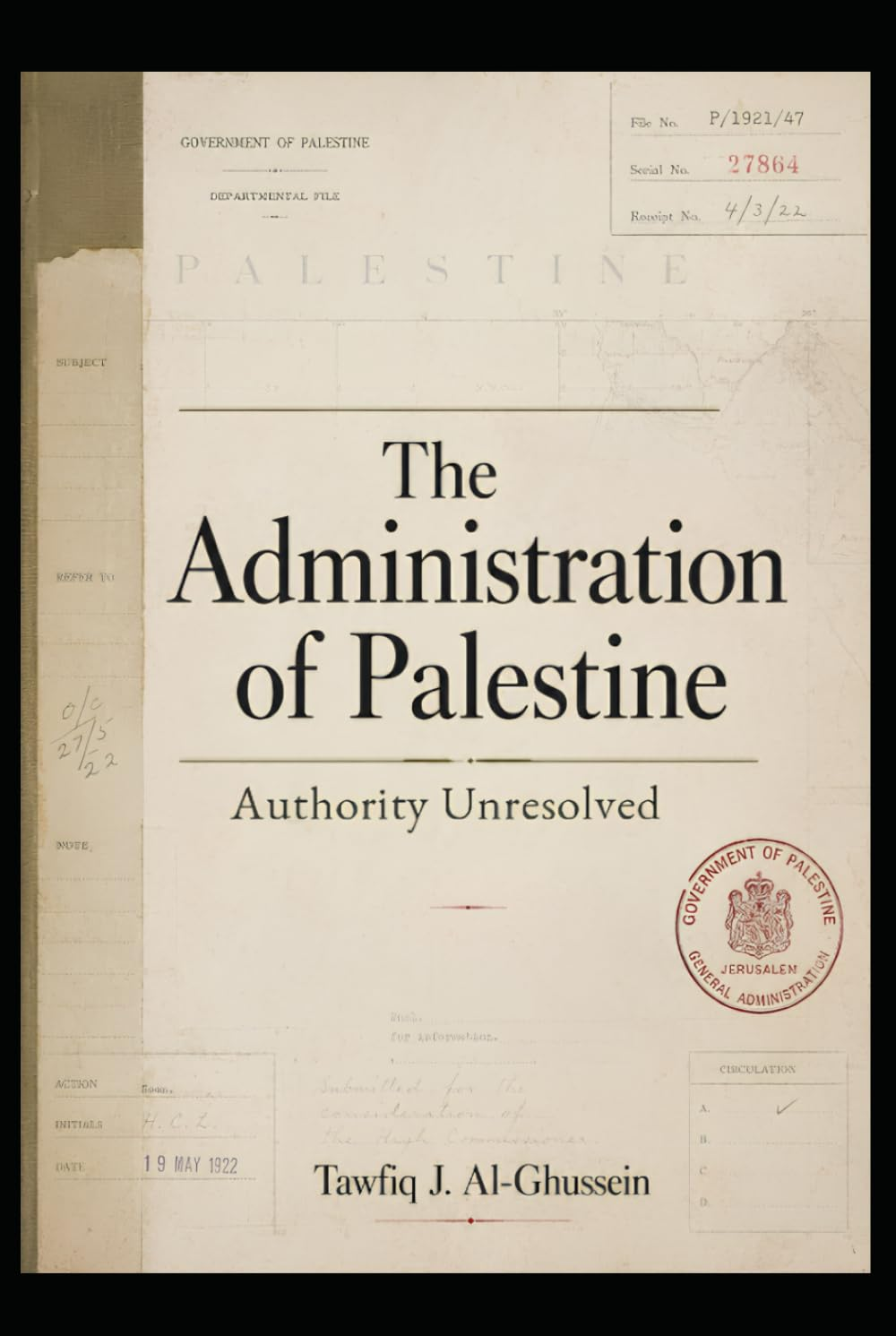
The Administration of Palestine: Authority Unresolved
The book examines a question that has remained unresolved for more than a century: who governs Palestine, by what authority, and in whose interests?

News & opinions from a Palestinian-American
living & working in Ramallah/Al-Bireh, Palestine

18 post/s found with this tag.
The book examines a question that has remained unresolved for more than a century: who governs Palestine, by what authority, and in whose interests?
![Stranger in My Own Land: Palestine, Israel and One Family’s Story of Home by Fida Jiryis [Book Review]](https://epalestine.ps/sambahour/wp-content/uploads/2022/09/stranger-in-my-own-land-1183647562.jpeg)
I am ecstatic to be able to share with you the first review of the forthcoming book, Stranger in My Own Land: Palestine, Israel and One Family’s Story of Home, by Fida Jiryis. It was published in Le Monde diplomatique (English edition), September 2022 Issue, as part of their Palestine special report. For over a decade, I witnessed the making of this landmark memoir from concept to publishing. All I can say is R-E-S-P-E-C-T to the author and publisher. Order your copy today; this is not one to be missed!
![Palestinians never stop conceding, for nothing in return [Book Review]](https://epalestine.ps/sambahour/wp-content/uploads/2022/06/the-olive-branch-from-palestine-2038246591.png)
Jerome M. Segal’s book has one main goal, which is to highlight the 1988 Palestinian Declaration of Independence as a lost inflection point: a rare, pivotal moment that the US, Israel, and even the Palestinian leadership who issued it, could have seized (but did not) to advance Palestinian statehood and peace between Palestinians and Israelis. “If it seems odd that a Jew should offer his thoughts on how Palestinians can be successful in their struggle, let me only add that the struggle for an independent Palestinian state is also the struggle for a humane and safe Israel, and that there can be no Judaism without a commitment to Justice.”


![‘The Two-State Delusion,’ a well-researched but mistitled saga of a failed peace process [Book Review]](https://epalestine.ps/sambahour/wp-content/uploads/2016/12/9780143129172-1.jpg)
University of Massachusetts Boston professor Padraig O’Malley’s The Two-State Delusion’s title suggests that there is something paradoxical in persevering with a proposed solution of two states, Israel and Palestine, as a way forward; the thrust of the historical accounts and the arguments made, however, are actually geared more toward convincing the reader that what failed is the process rather than the two-state paradigm itself, which has never yet been tested. A more accurate title would have been “Eulogy for a U.S.-Monopolized Peace Process.”
![Malkit Shoshan's "Atlas of the Conflict: Israel-Palestine" reference book [Recommended]](https://epalestine.ps/sambahour/wp-content/uploads/2025/03/atlas-of-the-conflict-cover.jpg)