
Haaretz
Why Israel pretends Mohammed isn’t there
It isn’t a matter of racism. It’s a matter of denial.
By Asher Schechter | Sep. 28, 2014
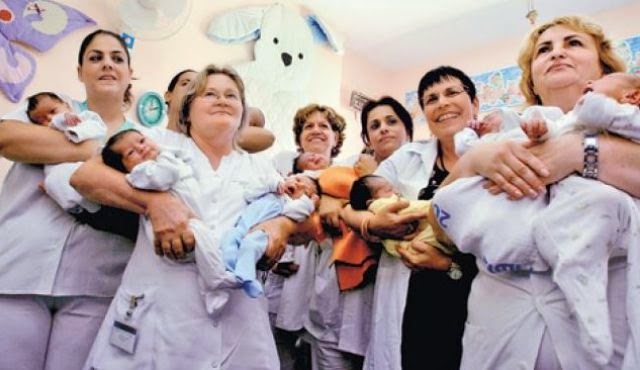 |
| Babies born in Israel. Photo by Ancho Gosh |
Earlier this week, Israel’s Population, Immigration and Borders Authority (PIBA) released its annual statement for Rosh Hashanah. Filled with tidbits about Israel’s population, such as the official number of Israeli citizens (8,904,373) and how many births occurred during the outgoing Jewish year (176,230), a main attraction in PIBA’s annual publication is the list of most-popular baby names.
The year 5774 saw a stunning upset when it came to girls: Tamar dethroned Noa. Regarding boys, the most popular names stayed Yosef, Daniel and Uri.
But Yosef wasn’t actually the most popular baby name in Israel. That, as reported by Haaretz’s Ilan Lior last week, was in fact Mohammad.
One would be hard-pressed not to suspect racism. No distinctly-Arab baby name made it to the top 10 of popular baby names in Israel (Yosef and Adam are common among both Jews and Arab-Israelis), although Arabs account for 20% of Israel’s population.
On the face of it, the omission smacks of a deliberate attempt to exclude the Arab population of Israel from yet another thing Israeli. Yet this isn’t a matter of simple, blatant racism. It’s worse. It’s denial.
Denial of what? First of all of Arabs, of course. Failing to acknowledge the existence of its big Arab population is a much subtler of exclusion, and in a way worse than outright racism: at least when we discriminate, we acknowledge the other.
But mostly it’s a denial of a reality that isn’t convenient. In recent years, Israel has developed a habit of trying to embellish or simplify reality by ignoring inconveniences. Let’s call it the “not counting the Haredim and Arabs” trick.
Peek-a-boo, I don’t see you
For instance, back in April 2012, PM Netanyahu made a revealing admission. Asked about the extreme inequality in Israel and the surge of public anger, as shown in the social protests of 2011, Netanyahu claimed: “If you deduct the Arabs and the Haredim from inequality indices, we are doing great.”
His statement caused an uproar but since then, the claim that Israel is doing just great if you don’t count it’s most impoverished groups has become a cliche of sorts among Israeli officials: if not for those pesky Haredim and Arabs, Israel would have been one of the most advanced countries in the OECD.
A study conducted by the Taub Center for Israel Studies in 2013 proves that even if you discount the Haredim and Arabs, Israel remains a poor, unequal, relatively-unproductive country by OECD standards. But the misconception has become entrenched, appropriated by ordinary and official Israelis for other walks of life beyond economics, whether it’s Israel’s troubled education system or, well, baby names.
In that sense, if you don’t count the name Mohammad, Israel’s most popular baby name is Yosef. And if you deduct the Arab population, Israel is a Jewish state. It’s a cool mental trick, that enables Israel to be the Jewish country it always wanted to be. It also implies, quite ominously, that Israel as a nation has lost some capacity of dealing with reality.
For years now, for instance, Israel has been concerned with the so-called “demographic threat”, a scenario in which Palestinians, both within Israel and in the Occupied Territories, become a majority thanks to their high birth rates and therefore risk Israel’s Jewish majority and its status as a Jewish state. Prime Minister Benjamin Netanyahu was among the first to raise this concern, back in 2003. Some analysts suggested the fear of it forced Ariel Sharon to unilaterally disengage from Gaza.
Which brings us back to Mohammad, and the reality that its omission masks. After all, what is the acknowledgement that Mohammad is the now most popular baby name in Israel, if not an embarrassing admission that the so called “demographic bomb” has already exploded? That Israel, despite its definition of itself as Jewish, is a lot less Jewish than it would have liked? How would you like a dose of demographic gunpowder with your honey-dipped apple this year?
But, if you deduct Mohammad, everything seems just fine. We are not racists, we swear, we are simply escaping to a much-less complicated fantasy land.
SOURCE: http://www.haaretz.com/news/features/.premium-1.618013
_____________________________________
Everything about this list:
http://lists.riseup.net/www/info/epalestine
To subscribe, send mail to:
epalestine-subscribe@lists.riseup.net
To unsubscribe, send mail to:
epalestine-unsubscribe@lists.riseup.net
Author

By Topic
Explore the site in BY TOPIC, A-Z.
!["Palestine in Pieces: Graphic Perspectives on the Israeli Occupation" by Kathleen & Bill Christison [Recommended]](https://epalestine.ps/sambahour/wp-content/uploads/2025/03/Palestine-in-Pieces-kathleen-bill-christison-980x1176.jpg)