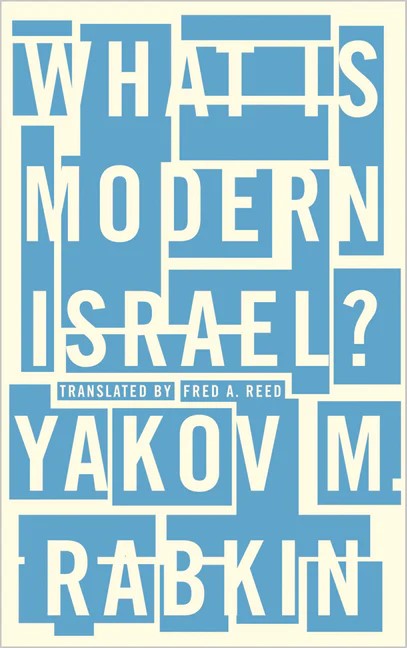
Review of What is Modern Israel? by Yakov M. Rabkin
As someone who gives political talks from a Palestinian vantage point to groups traveling through Palestine, I have spoken to thousands of Jews, among others, from around the world.
I walked away from reading Professor Yakov M. Rabkin’s What is Modern Israel? with the burning desire to call back every one of those Jewish travelers and sit down with them, one on one over a hot cup of mint tea — so that I could read them each of his chapters aloud, looking up and into their eyes at the end of every chapter to ask somberly, Do you get it now? You’ve been had, collectively. You’ve been lied to, collectively. You’re being used, collectively. Your religion, a rich one, has been hijacked, purposely.
“Shows that Zionism was conceived as a sharp break with Judaism and Jewish continuity.”
Publisher review from Pluto Press
Few countries provoke as much passion and controversy as Israel. What is Modern Israel? convincingly demonstrates that its founding ideology - Zionism - is anything but a simple reaction to antisemitism. Dispelling the notion that every Jew is a Zionist and therefore a natural advocate for the state of Israel, Yakov Rabkin points to the Protestant roots of Zionism, in order to explain the particular support Israel musters in the United States.
Drawing on many overlooked pages of history, including English, French, Hebrew, Yiddish and Russian sources, Yakov Rabkin shows that Zionism was conceived as a sharp break with Judaism and Jewish continuity. Israel’s past and present must be seen in the context of European ethnic nationalism, colonial expansion and geopolitical interests, rather than as an incarnation of Biblical prophecies or a culmination of Jewish history. (Pluto Press)
Sam Bahour is a Palestinian-American business consultant, writer, and commentator based in Al-Bireh/Ramallah, Palestine. He is the principal of Applied Information Management (AIM), a consultancy specializing in business development and startup advisory services.
Bahour was instrumental in establishing two of Palestine’s publicly traded companies: the Palestine Telecommunications Company (PALTEL) and the Arab Palestinian Shopping Centers (APSC). He co-founded Americans for a Vibrant Palestinian Economy (A4VPE), of which he is now an emeritus member, and served as an independent director on the board of Arab Islamic Bank P.L.C. from 2004 to 2025. He currently serves on the board of Just Vision and The Palestine Economic Policy Research Institute (MAS).
He frequently gives talks to delegations visiting Palestine on the subjects of Palestine’s political economy, Palestinian Politics 101, and a general orientation to the state of affairs under Israeli military occupation.
A prolific writer on Palestinian affairs, Bahour has been published in major international outlets including The New York Times, The Guardian, Haaretz, The Washington Post, The Boston Globe, the Los Angeles Times, Al Jazeera America, Le Monde diplomatique, Al-Monitor, +972 Magazine, The Hill, and Arab News. He has appeared as a commentator on NPR, CNN, BBC, and other broadcast media.
Bahour is the co-editor of Homeland: Oral Histories of Palestine and Palestinians (Olive Branch Press, 1993) and was profiled in the bestselling anthology Kingdom of Olives and Ash, edited by Michael Chabon and Ayelet Waldman, in a chapter authored by Chabon titled “The Tallest Man in Ramallah.” He holds an Associate’s and Bachelor’s degree in Computer Technology from Youngstown State University, and a Kellogg-Recanati International Executive MBA — a joint program of the Kellogg School of Management at Northwestern University and the Recanati Business School at Tel Aviv University.



![An American Evangelical Christian Man’s Awakening to Palestine [Book Review]](https://epalestine.ps/sambahour/wp-content/uploads/2022/07/glory-to-god-1544954625.png)
