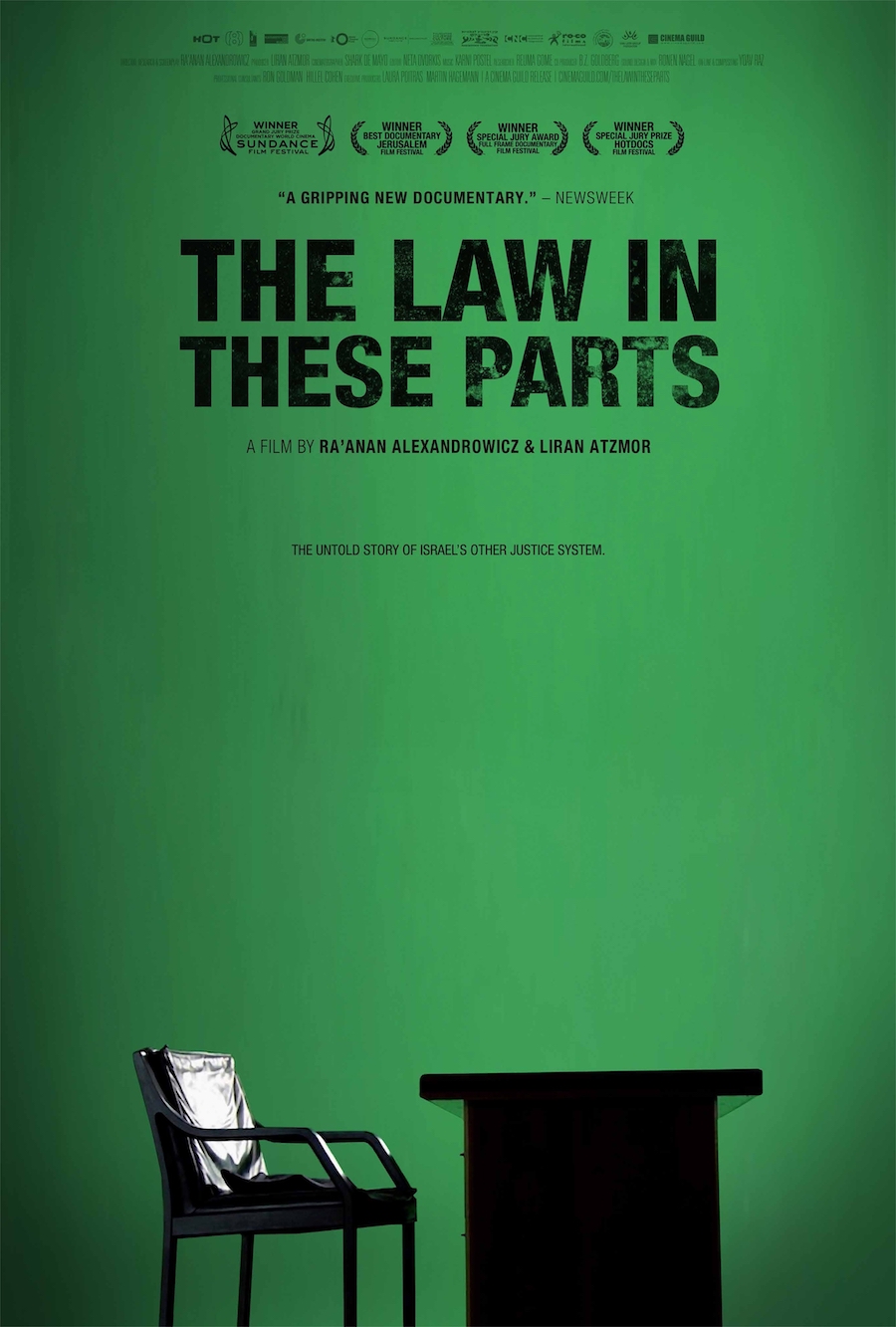
Through archival footage and interviews with Israeli military judges, prosecutors and legal advisors, THE LAW IN THESE PARTS unravels an intricate system of military control that symbolizes one of the most enduring and damaging conflicts of our time, and examines what happens when measures driven by security considerations become permanent reality.
Official Trailer
Synopsis
Can a modern democracy impose a prolonged military occupation on another people while retaining it's core democratic values? Since Israel conquered the territories of the West Bank and Gaza Strip in the 1967 war, the military has imposed thousands of orders and laws, established military courts, sentenced hundreds of thousands of Palestinians, enabled half a million Israeli "settlers" to move to the Occupied Territories and developed a system of long-term jurisdiction by an occupying army that is unique in the entire world.
The men entrusted with creating this new legal framework were the members of Israel's military legal corps. Responding to a constantly changing reality, these legal professionals have faced (and continue to face) complex judicial and moral dilemmas in order to develop and uphold a system of long-term military “rule by law” of an occupied population, all under the supervision of Israel's Supreme Court, and, according to Israel, in complete accordance with international law.
The Law In These Parts explores this unprecedented and little-known story through testimonies of the military legal professionals who were the architects of the system and helped run it in its formative years.
The film attempts to ask some crucial questions that are often skirted or avoided: Can such an occupation be achieved within a legal framework that includes genuine adherence to the principals of rule-of-law? Should it? What are the costs that a society engaged in such a long term exercise must bear? And what are the implications of the very effort to make a documentary film about such a system?
Sam Bahour is a Palestinian-American business consultant, writer, and commentator based in Al-Bireh/Ramallah, Palestine. He is the principal of Applied Information Management (AIM), a consultancy specializing in business development and startup advisory services.
Bahour was instrumental in establishing two of Palestine’s publicly traded companies: the Palestine Telecommunications Company (PALTEL) and the Arab Palestinian Shopping Centers (APSC). He co-founded Americans for a Vibrant Palestinian Economy (A4VPE), of which he is now an emeritus member, and served as an independent director on the board of Arab Islamic Bank P.L.C. from 2004 to 2025. He currently serves on the board of Just Vision and The Palestine Economic Policy Research Institute (MAS).
He frequently gives talks to delegations visiting Palestine on the subjects of Palestine’s political economy, Palestinian Politics 101, and a general orientation to the state of affairs under Israeli military occupation.
A prolific writer on Palestinian affairs, Bahour has been published in major international outlets including The New York Times, The Guardian, Haaretz, The Washington Post, The Boston Globe, the Los Angeles Times, Al Jazeera America, Le Monde diplomatique, Al-Monitor, +972 Magazine, The Hill, and Arab News. He has appeared as a commentator on NPR, CNN, BBC, and other broadcast media.
Bahour is the co-editor of Homeland: Oral Histories of Palestine and Palestinians (Olive Branch Press, 1993) and was profiled in the bestselling anthology Kingdom of Olives and Ash, edited by Michael Chabon and Ayelet Waldman, in a chapter authored by Chabon titled “The Tallest Man in Ramallah.” He holds an Associate’s and Bachelor’s degree in Computer Technology from Youngstown State University, and a Kellogg-Recanati International Executive MBA — a joint program of the Kellogg School of Management at Northwestern University and the Recanati Business School at Tel Aviv University.





!["Palestine in Pieces: Graphic Perspectives on the Israeli Occupation" by Kathleen & Bill Christison [Recommended]](https://epalestine.ps/sambahour/wp-content/uploads/2025/03/Palestine-in-Pieces-kathleen-bill-christison-980x1176.jpg)